
Video credit: Ark Films
Matthew begins the New Testament with something many readers are tempted to skip: a long list of names.
Abraham. Isaac. Jacob. Judah. Perez.
And then, suddenly, a name jumps out:
Tamar.
Why would Matthew deliberately mention Tamar in the genealogy of Jesus? Her story in Genesis 38 is complicated, uncomfortable, and anything but the sort of family story most people would proudly print on a Christmas card.
Yet Matthew doesn’t hide her.
He puts her right near the beginning of the genealogy of Jesus Christ.
That is what makes the story so fascinating. Tamar’s place in Jesus’ genealogy raises big questions about God’s grace, redemption, unexpected people, family history, and the Messiah.
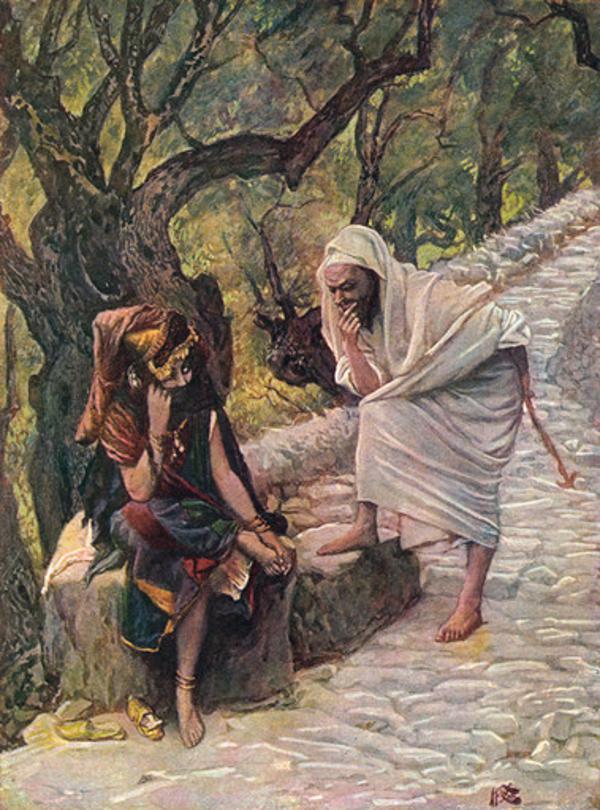
Image credit: FeelTheArt / James Tissot, “The Meeting of Tamar and Judah”
Who Was Tamar in the Bible?
Tamar was Judah’s daughter-in-law. Judah was one of Jacob’s sons and therefore part of the family line that would eventually lead to Israel’s tribes and, much later, to Jesus.
Genesis 38 tells a difficult story. Tamar’s husband Er dies, and she is then connected to Onan, who also dies. Judah tells Tamar to remain a widow until his youngest son, Shelah, is old enough to fulfill the family obligation. But time passes, and Judah does not follow through.
Tamar is left waiting.
And waiting.
And waiting.
Eventually, Tamar takes matters into her own hands. She disguises herself, encounters Judah without him recognizing her, and becomes pregnant. When Judah discovers what has happened, Tamar produces the personal items he had left with her. Judah realizes that she has acted more righteously than he has in the matter.
The story is unusual, morally messy, and difficult to read. Yet that is exactly why her appearance in Matthew is so striking.
You can read the full Genesis 38 account of Judah and Tamar before continuing.
Why Did Matthew Include Tamar in Jesus’ Genealogy?
Matthew could have simply listed Judah as the father of Perez.
Instead, he says Perez was born through Tamar.
That detail matters.
Matthew’s genealogy is not simply a database of ancestors. It introduces Jesus as the Messiah, the son of David and the son of Abraham, and it deliberately highlights particular people and relationships.
Tamar is the first woman named in the genealogy.
Then Matthew names Rahab.
Then Ruth.
Then the woman who had been the wife of Uriah, referring to Bathsheba.
And finally Mary.
That’s a very unusual family tree.
The pattern seems designed to make us stop and think. These are not the predictable names you’d expect in a polished royal genealogy. They remind readers that the story leading to Jesus includes surprising people, painful circumstances, outsiders, failures, courage, and grace.
The site’s Anointed Three Times – David and Jesus explores another example of how the author sees unexpected Old Testament details pointing toward Jesus.
Tamar’s Story Is About More Than Scandal
One of the easiest mistakes is to reduce Genesis 38 to its most shocking details.
But Tamar’s story is also about injustice, waiting, family duty, recognition, and the continuation of a family line.
Judah had promised Tamar a future through Shelah, yet that future never arrived. Tamar was effectively left on the sidelines while the family moved on.
Her actions are certainly controversial. Scripture does not present the situation as a cheerful little life lesson. At the same time, the story ends with Judah acknowledging that Tamar had acted more righteously than he had.
That moment changes how we should read the chapter.
It isn’t simply “Look at Tamar’s mistake.”
It also asks, “Who was failing whom?”
That is a much deeper question.
Tamar and the Birth of Perez
Tamar gives birth to twins, Perez and Zerah.
And Perez becomes the crucial link.
Matthew 1 places Judah, Tamar, and Perez directly in the ancestry leading to Jesus. The biblical genealogy then continues from Perez to Hezron, Ram, Amminadab, Nahshon, Salmon, Boaz, Obed, Jesse, and David.
The chain keeps moving.
One generation after another.
One name after another.
Until it eventually reaches Christ.
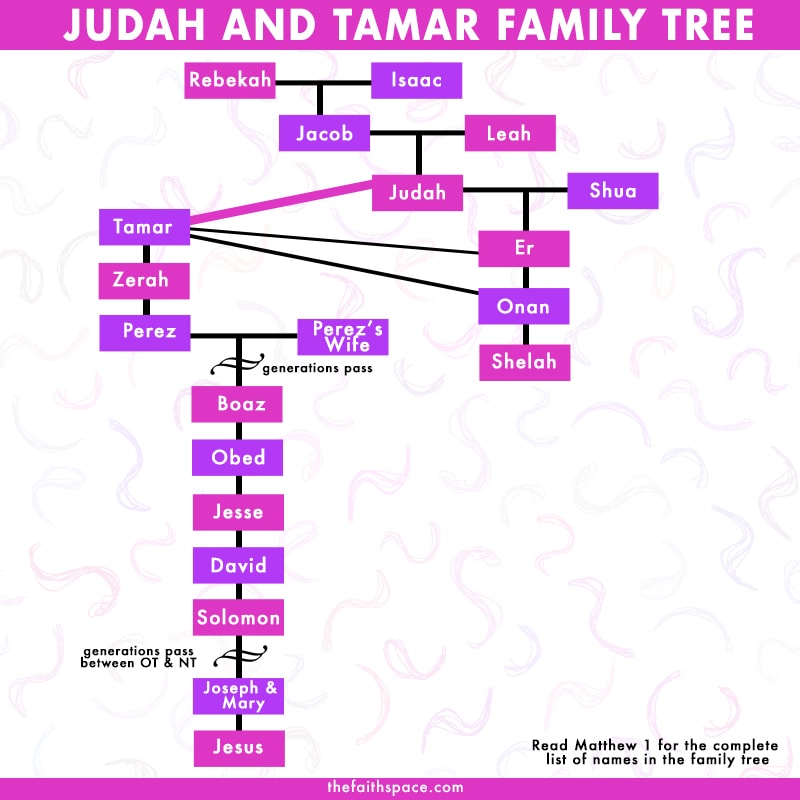
Image credit: The Faith Space
The family tree makes the connection much easier to see. Tamar’s story does not sit beside the Messianic line. Her son Perez sits directly inside it.
The original Living Room Theology perspective consistently emphasizes this idea of reading the Old Testament as a connected story that points toward Jesus. Its article God Provides Himself the Lamb takes a similar Christ-centered approach when reading Genesis 22.
Why Are Women Named in Matthew’s Genealogy?
This is one of the biggest questions surrounding Matthew 1.
Matthew names five women: Tamar, Rahab, Ruth, Bathsheba, and Mary.
That is significant because genealogies in the ancient world often focused heavily on male lineage. Matthew’s decision to name these women makes the genealogy stand out immediately.
And look at their stories.
- Tamar is connected to a deeply complicated family situation.
- Rahab lived in Jericho and is remembered for protecting Israelite spies.
- Ruth was a Moabite who joined herself to Naomi and eventually married Boaz.
- Bathsheba is referred to through her relationship to Uriah and the painful story involving David.
- Mary becomes the mother of Jesus through the work of the Holy Spirit.
Matthew seems to be saying something without giving us a giant neon sign:
God’s plan does not depend on a perfectly tidy human family tree.
The Why Did God Send Jesus? article explores the site’s broader understanding of Jesus’ mission and the life God brings through him.
Tamar Shows That God Can Work Through Complicated Stories
Let’s be honest. Most families have at least one story nobody wants brought up during dinner.
Some families have several.
The Bible is remarkably honest about human failure. It doesn’t scrub the family history before publishing it.
Abraham makes mistakes.
Jacob deceives people.
Judah fails badly.
David commits serious wrongdoing.
And yet God’s redemptive story continues.
This does not mean the Bible approves every action its characters take. It means their failures do not have the power to cancel God’s purposes.
That distinction is important.
The site’s Jesus: I Am the Burning Bush article likewise reads difficult Old Testament material through a Christ-centered lens, especially around themes of sin, forgiveness, life, and Jesus’ identity.
Was Tamar a Canaanite?
You may see some Bible studies describe Tamar as a Canaanite woman. The important thing is to be careful here.
Genesis tells us Judah married a Canaanite woman, but it does not explicitly identify Tamar’s ethnicity in the same direct way.
That matters because the genealogy is sometimes used to make a larger point about outsiders being included in God’s redemptive story. That point can certainly be discussed, especially when we consider Rahab and Ruth, but Tamar’s own ethnicity should not be stated as certain when Genesis does not clearly do so.
Good Bible study sometimes means saying, “We don’t know.”
That’s not weakness.
That’s honesty.
The Bereans examining the Scriptures daily article emphasizes careful examination rather than simply accepting an interpretation because someone said it confidently.
What Does Tamar Have to Do With Jesus?
This is where the genealogy becomes much more than a list of names.
Matthew introduces Jesus as the Messiah, the son of David and the son of Abraham. Tamar appears near the beginning of the line that leads there.
For Christians, that creates a powerful picture of redemption.
God does not wait for history to become spotless before carrying out his purposes.
Instead, he works through real people living in a real, broken world.
The genealogy therefore becomes a reminder that Jesus entered human history through an imperfect family line.
And that is exactly why the story feels so relatable.
Most of us don’t come from a flawless family tree either.
There are disappointments, awkward chapters, broken relationships, mistakes, and things we’d rather rewrite.
Yet Christianity says those things do not have to be the final chapter.
The article Experiencing Jesus Opens the Bible: Seeing Jesus describes the author’s broader shift toward reading Scripture through the life and character of Jesus.

Image credit: Daniel Grove’s Blog
Tamar, Rahab, Ruth and Bathsheba: A Pattern Emerges
When you put these women side by side, an interesting pattern appears.
None of them fits the image of a completely ordinary genealogy entry.
And Matthew keeps naming them.
Why?
One reasonable Christian reading is that Matthew wants readers to see how God’s promise moves through unexpected circumstances. Another is that he wants to emphasize the reach of God’s grace and the surprising people who become part of the Messiah’s story.
Different Bible scholars and Christian traditions offer different explanations for Matthew’s choice, so it is wise not to pretend there is only one possible answer.
But Matthew’s editorial decision is impossible to miss.
He wants us to see these women.
The related Jesus: The True Bread from Heaven teaching offers another example of how the site’s author traces patterns from the Old Testament into the life and teaching of Jesus.
Why Did Judah’s Line Continue?
This question takes us back to the promises surrounding Judah.
Genesis 49 presents Judah as the son associated with kingship and rule. Later generations make that connection clearer through David.
Jesus is then presented in the New Testament as the promised Messiah who comes from David’s line.
So Tamar’s story is not an isolated family drama.
It sits inside a much larger story involving Judah, Perez, David, and Jesus.
The original site’s David and Jesus study explores the relationship between David’s kingship and the author’s understanding of Jesus as King.
What Can Tamar Teach Us About Grace?
Perhaps the most powerful lesson is that grace does not mean pretending the past never happened.
Tamar’s story is not cleaned up.
Judah’s failure is not hidden.
The circumstances are not made pretty.
Instead, the story moves forward.
That’s an important distinction.
Grace is not denial.
Grace is redemption.
A person can have a complicated past and still have a meaningful future.
A family can carry painful history and still become part of a story of hope.
And a chapter that looks like the end can sometimes become the beginning of something nobody expected.
The Bible Study: Why? How? What? article encourages readers to slow down, ask questions, and look for the larger story rather than rushing through familiar passages.
Is Tamar’s Inclusion Really About Shame?
Not necessarily.
Some older interpretations focus heavily on the scandal of Tamar’s story. Others emphasize grace, unusual circumstances, justice, or the inclusion of women and outsiders.
The safest conclusion is that Matthew intentionally names her because her story is relevant to the genealogy and because Matthew wants his readers to know exactly which Perez he is talking about.
At the same time, the placement of Tamar alongside Rahab, Ruth, Bathsheba, and Mary clearly invites theological reflection.
The genealogy isn’t pretending Jesus came from a picture-perfect collection of ancestors.
It tells the truth.
And truth makes the story more powerful.
How Tamar Points Toward the Gospel
The gospel is about God acting in history to bring redemption through Jesus.
Tamar’s story reminds us that God’s purposes often move through circumstances humans would never choose for themselves.
There is failure.
There is waiting.
There is uncertainty.
And then there is a future that Tamar could not possibly have seen coming.
Her son Perez becomes part of the line that leads to David, and Matthew traces that line ultimately to Jesus.
The Living Room Theology article God Provides Himself the Lamb similarly sees Genesis as containing patterns that Christians can read in light of Christ.
Whether you agree with every symbolic connection made in those interpretations, the larger biblical point remains striking: Jesus enters a messy human history and brings God’s redemption into it.
A Family Tree Doesn’t Tell the Whole Story
Here’s something worth remembering.
A family tree can tell you who belongs to whom.
It cannot tell you everything about those people.
It doesn’t show their tears.
It doesn’t show their prayers.
It doesn’t show the days they felt forgotten.
It doesn’t show the moments when they wondered whether anything good could possibly come from their situation.
Matthew gives us the names.
Genesis gives us the story.
And together they show us something Tamar’s family probably could not see while they were living it.
Their complicated story was moving somewhere.
Why Tamar’s Name Still Matters Today
Tamar is not just a name buried inside Matthew 1.
Her story challenges the way we think about people.
Who gets remembered?
Who gets left out?
Who deserves another chance?
Can someone who has experienced rejection still have a meaningful future?
Can God work through people whose lives look messy from the outside?
Matthew’s genealogy quietly answers with a powerful yes.
That’s one reason the genealogy of Jesus is worth reading rather than skipping.
The names are not filler.
They carry stories.
And Tamar’s story is one of the most surprising of them all.
Final Thoughts: Why Is Tamar Listed in Jesus’ Genealogy?
So, why is Tamar listed in Jesus’ genealogy?
Because Tamar’s story is part of the real history that leads to Jesus through Judah and Perez. Matthew deliberately names her, even though her story is complicated and would hardly qualify as a picture-perfect family tale.
Her inclusion reminds us that the genealogy of Jesus is not a museum of flawless people.
It is a record of real people, real struggles, unexpected turns, and God’s continuing purpose.
And that may be the most encouraging part.
God’s redemptive story is bigger than the messiest chapter in your family history.
Tamar could not have known that her name would one day appear in the genealogy of the Messiah.
Neither could Perez.
Neither could many of the names that follow.
Yet the story kept moving.
Generation after generation.
Until it reached Jesus.
And that is why Tamar’s name deserves more than a quick glance in Matthew 1. It deserves a pause, a second look, and perhaps one final question:
What might God be doing in your story that you cannot see yet?
Well, THAT is NOT Yeshua’s lineage! fact. Mathews’s lineage is not the lineage of Yeshua. Not unless you are trying to imply the Joseph was the FATHER of Yeshua and if you are doing that you serve a different God than I do.