
Video credit: Grace Orthodox Presbyterian Church
Jesus once made a statement that would have stopped his audience in their tracks: “Something greater than Solomon is here.”
That may sound simple to modern ears. It wasn’t.
Solomon was one of the most famous kings in Israel’s history. He was known for extraordinary wisdom, immense wealth, a magnificent kingdom, and the building of the Temple in Jerusalem. The Queen of Sheba traveled a great distance specifically to hear his wisdom, and after seeing his court, his Temple worship, and his kingdom, she was overwhelmed by what she witnessed.
Then Jesus arrived and essentially said, “Someone greater than Solomon is standing right here.”
So what did Jesus mean? Was he claiming greater wisdom? A greater kingdom? A greater Temple? A greater kind of wealth? Or was he pointing to something far more important?
Let’s open the story and look at the surprising ways Jesus is presented as greater than Solomon.
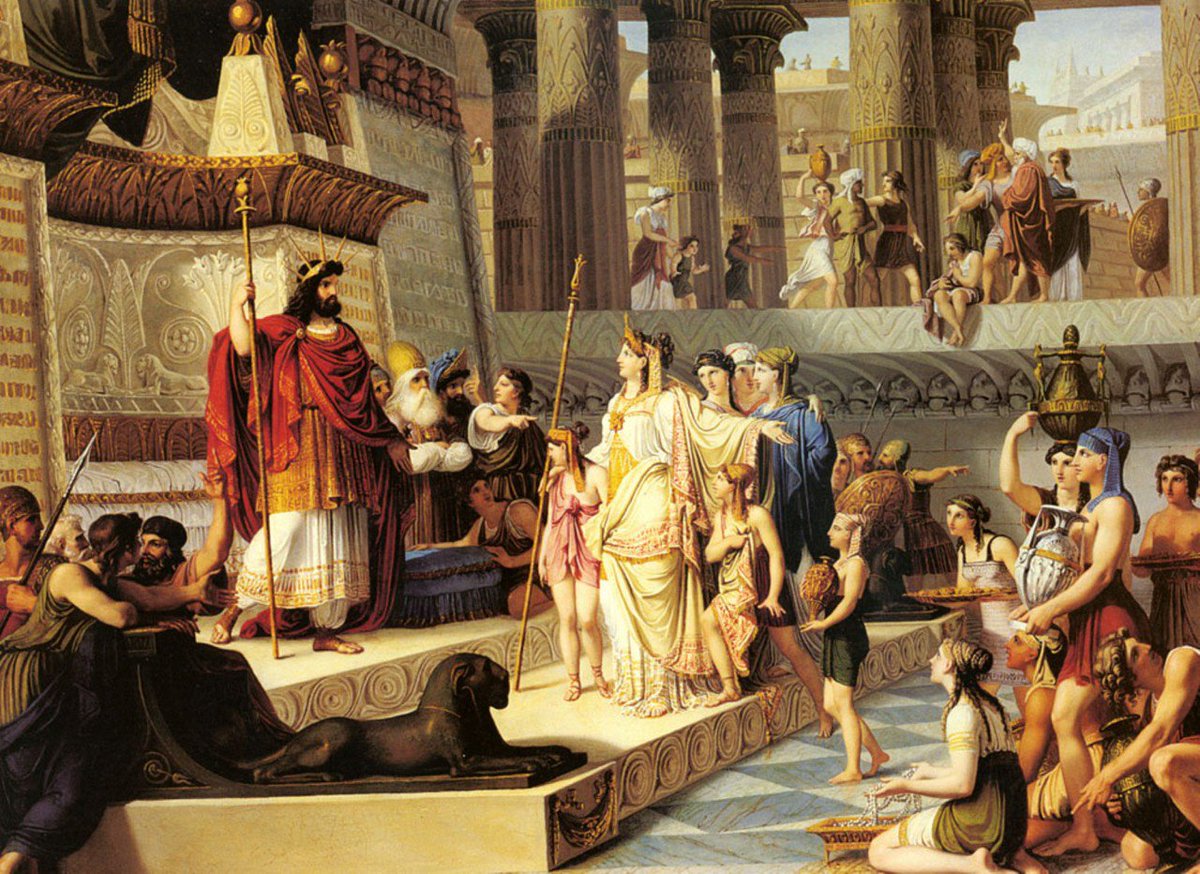
Image credit: The Bible in Paintings / artwork depicting the Queen of Sheba’s visit to Solomon
Who Was Solomon?
Before understanding why Jesus is greater than Solomon, we need to remember just how impressive Solomon was.
Solomon was the son of David and became king of Israel after David. Early in his reign, God offered him the opportunity to ask for what he wanted. Solomon asked for an understanding heart so that he could govern God’s people wisely.
That request pleased God.
Solomon became famous for wisdom and judgment. His reputation spread far beyond Israel. The Queen of Sheba heard reports about him and traveled to Jerusalem to test him with difficult questions.
According to 1 Kings 10, Solomon answered her questions and displayed a kingdom filled with wealth, organization, servants, food, architecture, and worship.
The Queen of Sheba was left amazed.
And then Jesus says that someone greater than Solomon was already present.
That is the central question of this entire article.
Why Did Jesus Mention the Queen of Sheba?
Jesus’ statement appears in Matthew 12:42 and Luke 11:31. He was speaking to people who had already witnessed his teaching and miracles, yet many still demanded more signs.
Jesus pointed them backward to the Queen of Sheba.
She had heard about Solomon’s wisdom and traveled from far away because she wanted to hear it for herself. Jesus’ audience, on the other hand, had something far greater standing directly in front of them.
They were closer to greater wisdom—and still refused to listen.
That makes the passage less like a compliment about Solomon and more like a challenge to Jesus’ listeners.
Imagine traveling hundreds of miles to hear an exceptionally wise king, only to reject the greatest teacher standing in your own town.
That’s the point Jesus was making.
You can read the full Matthew 12 passage and see how the Queen of Sheba fits into Jesus’ wider argument.
Jesus Is Greater Than Solomon in Wisdom
Solomon’s wisdom was legendary.
1 Kings 4 says God gave Solomon wisdom and understanding beyond measure. His wisdom became known throughout the surrounding nations.
Yet the New Testament makes a remarkable claim about Jesus.
Paul describes Christ as “the wisdom of God.”
That’s a completely different category.
Solomon received wisdom from God.
Jesus, in Christian theology, is presented as the one in whom God’s wisdom is revealed.
That’s why the statement “greater than Solomon” is so powerful. Jesus wasn’t simply claiming to have a higher IQ than an ancient king. He was pointing to the source and fullness of divine wisdom.
Solomon could answer difficult questions.
Jesus could reveal the heart behind the questions.
Solomon could explain earthly matters.
Jesus taught about the kingdom of God, eternal life, forgiveness, the human heart, and the Father’s will.
The original Living Room Theology article connects this with the New Testament language of Christ as God’s wisdom. That same Christ-centered approach appears in Experiencing Jesus Opens the Bible: Seeing Jesus.
Solomon Had Wisdom, But Jesus Is the Wisdom
That distinction is easy to miss.
Think of the difference between a lamp and the sun.
A lamp gives light.
The sun is a source of light on a completely different scale.
Solomon had extraordinary wisdom. Jesus, according to the New Testament, is not merely a person who possesses wisdom but is intimately identified with God’s wisdom.
Paul says that in Christ are hidden “all the treasures of wisdom and knowledge.”
Suddenly, Jesus’ claim makes much more sense.
He’s not saying, “I have a little more wisdom than Solomon.”
He’s pointing to a greater source of truth.
The related Jesus: The True Bread from Heaven study makes a similar argument when it presents Jesus as the full reality behind Old Testament images and symbols.
A Greater Temple Than Solomon Built
Solomon’s greatest construction project was the Temple in Jerusalem.
It was magnificent.
The Temple represented the dwelling place of God among Israel and became one of the defining achievements of Solomon’s reign.
Yet the New Testament presents an astonishing alternative.
Jesus builds a living house.
Instead of constructing a building from stone and cedar, Christ builds a people.
Peter describes believers as “living stones” being built into a spiritual house.
Paul likewise describes believers collectively as God’s temple, with God’s Spirit dwelling among them.
That means the contrast is enormous.
Solomon built a magnificent Temple.
Jesus builds a living community.
Solomon’s Temple could be entered, admired, and eventually destroyed.
The spiritual house of Christ is made of people transformed by faith.
You can explore another Living Room Theology article, I Will Build You a House, for a deeper look at the biblical theme of God’s house and what the author sees in it.
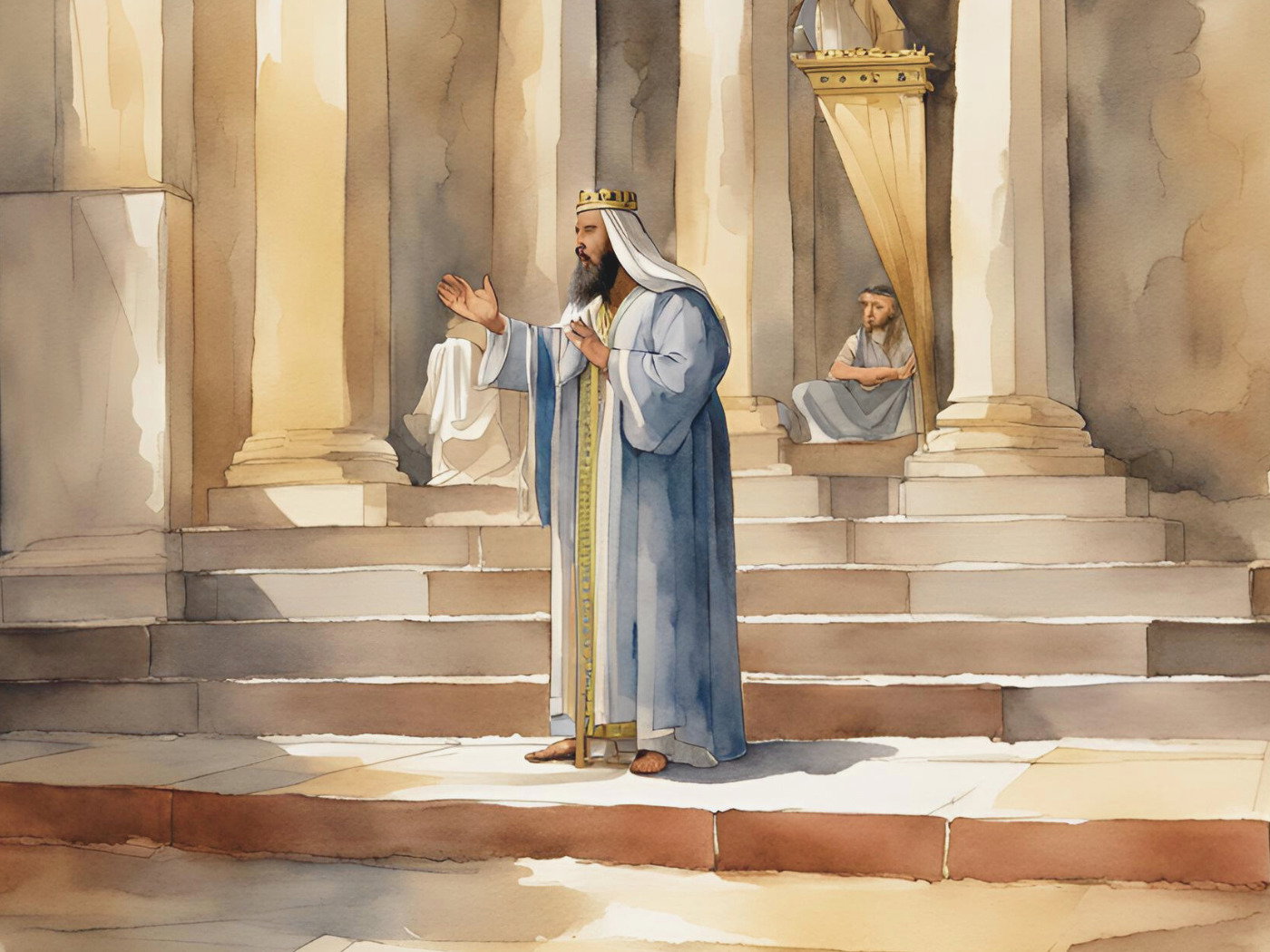
Image credit: Bíblia On, “Solomon’s Prayer at the Temple”
Solomon Had a Royal Table. Jesus Offers the Bread of Life.
When the Queen of Sheba saw Solomon’s table, servants, officials, and royal household, she was amazed.
Jesus offers something greater still.
In John 6, Jesus says, “I am the bread of life.”
That takes the idea of food far beyond an impressive royal meal.
Solomon’s table fed people physically.
Jesus speaks of life that reaches beyond physical hunger.
Solomon could provide abundant food for a kingdom.
Jesus presents himself as the one who gives life to the world.
That is why the original Living Room Theology article spends considerable time connecting Solomon’s table with Jesus as the true bread from heaven.
It is also why the site’s Why Did God Send Jesus? study emphasizes Jesus’ mission in terms of life, light, and God’s purpose in sending his Son.
Solomon Had Servants. Jesus Calls His People to Serve.
Now the comparison becomes wonderfully unexpected.
Solomon’s court displayed servants, attendants, officials, and cupbearers. The Queen of Sheba saw an organized royal household that reflected the king’s greatness.
Jesus turns the usual idea of greatness upside down.
He teaches that the greatest among his followers should be a servant.
He doesn’t simply sit on a throne and demand service.
He washes feet.
He serves.
He gives himself.
That’s a radically different picture of kingship.
Solomon displayed greatness through the glory of his court.
Jesus displays greatness through self-giving love.
That idea connects closely with What Is Required for Love?, which explores love and the way Jesus reframes it through his life and teaching.
Jesus’ Kingdom Is Greater Than Solomon’s Kingdom
Solomon ruled Israel during a remarkable period of peace and prosperity.
His kingdom became famous.
But it was still temporary.
Solomon died.
His kingdom eventually divided.
The political glory of his reign faded.
Jesus, however, is presented in the New Testament as the King whose kingdom is not limited to one geographical nation.
His kingdom is described in terms of God’s rule, eternal life, righteousness, peace, and the gathering of people from every nation.
That’s another reason Jesus can say something greater than Solomon is here.
Solomon’s kingdom was impressive.
Jesus’ kingdom is eternal.
The Living Room Theology article David Anointed Three Times explores another connection between Israel’s kingship and the Christian understanding of Jesus as the greater King.
Solomon Received Glory. Jesus Reveals God’s Glory.
When the Queen of Sheba arrived, she saw Solomon’s wealth, architecture, servants, food, and worship. The whole scene communicated royal greatness.
Jesus offers a different kind of glory.
John’s Gospel repeatedly presents Jesus as revealing God’s glory through his life.
Not merely through wealth.
Not through armies.
Not through golden buildings.
Instead, Jesus’ glory is revealed through truth, compassion, signs, suffering, sacrifice, death, and resurrection.
That is one of Christianity’s most surprising themes.
Jesus’ greatest moment doesn’t look like Solomon’s greatest moment.
Solomon’s glory is associated with splendor.
Jesus’ glory reaches its climax through the cross and resurrection.
The original site’s Jesus: I Am the Burning Bush article similarly interprets the burning bush as a powerful picture of Jesus’ death, life, and victory over death.

Image credit: Bible Art, illustration based on 1 Kings 3:9
The Queen of Sheba Came to Solomon. Who Comes to Jesus?
This is where Jesus’ comparison becomes especially interesting.
The Queen of Sheba heard about Solomon and came looking for wisdom.
Throughout the Gospels, people come to Jesus for different reasons.
Some want healing.
Some want answers.
Some want to challenge him.
Some want miracles.
Some simply want to hear him speak.
And some become followers.
Jesus is not hiding in a palace waiting for royalty to visit. He is walking among ordinary people—fishermen, families, outcasts, religious leaders, children, sick people, and travelers.
The contrast is striking.
People crossed great distances to see Solomon’s wisdom.
Jesus came to people.
That is another sense in which the greater King is different.
The Queen of Sheba Was Willing to Search
Jesus’ use of the Queen of Sheba also contains a warning.
She heard reports about Solomon and acted on them.
She searched.
She traveled.
She listened.
She tested what she had heard.
And when she encountered the reality, she recognized that the reports had not exaggerated Solomon’s greatness.
Jesus’ audience had something far greater.
They didn’t need to travel across deserts.
They didn’t need royal invitations.
The greater wisdom was standing in front of them.
Yet many still refused to listen.
That is why Why Were the Bereans Examining the Scriptures Daily? is a useful companion study. It emphasizes examining what we hear rather than blindly accepting or rejecting it.
Jesus Is Greater Because He Knows What Solomon Could Not
Solomon was brilliant, but he was still human.
He could make wise judgments, write proverbs, build impressive structures, and govern a nation.
But he could not conquer death.
He could not offer eternal life.
He could not become the source of God’s salvation for the world.
Jesus’ claim is therefore not merely about intelligence.
It’s about identity and mission.
The New Testament presents Jesus as the one through whom God brings salvation and life. The site’s Why Did Jesus Breathe the Spirit on the Disciples? explores this connection between Jesus, the Holy Spirit, peace, and life.
Solomon Was Wise, But He Also Had a Serious Weakness
This is an important part of the comparison.
Solomon’s story does not end the way it begins.
His wisdom was genuine. His achievements were enormous. But 1 Kings later describes his spiritual compromise, including his many marriages and the influence of foreign gods.
That means Solomon’s wisdom did not equal perfection.
He could be the wisest king of his generation and still make profoundly unwise choices.
Jesus is presented very differently.
His wisdom is not merely clever decision-making. It is perfectly aligned with the Father’s will.
That gives “greater than Solomon” another layer.
Jesus does not simply surpass Solomon’s best achievement.
He succeeds where Solomon ultimately failed.
Jesus Is Greater Than Solomon’s Temple
The Temple is one of the clearest symbols of Solomon’s reign.
But Jesus makes an extraordinary statement in the Gospels about the Temple.
He refers to something greater than the Temple in connection with himself.
That language should make us pause.
For centuries, the Temple had represented worship, sacrifice, priesthood, and God’s dwelling among Israel.
Jesus points toward himself as the greater reality.
That’s why the Living Room Theology article Anointed Three Times: David and Jesus and the study Jesus Is the Key to the God of Abraham, Isaac, and Jacob fit so naturally beside this discussion. Both explore the author’s larger interest in how Old Testament people, patterns, and institutions point readers toward Jesus.
Greater Wisdom Means Greater Questions
There is a funny little twist here.
We often think wisdom means having fewer questions.
But Jesus didn’t come simply to produce people who never ask questions.
He often answered questions with deeper questions.
He challenged assumptions.
He forced people to look at motives.
He exposed what was hiding underneath religious language.
Solomon was famous for answering hard questions.
Jesus went further by exposing the person behind the question.
That’s a very different kind of wisdom.
And that is exactly why “greater than Solomon” is such a powerful statement.
What Does This Mean for Us Today?
It is easy to admire Jesus from a distance.
It’s also easy to admire Solomon from a distance.
We can read their words, study their lives, and collect interesting facts.
But Jesus was not asking his listeners to become fans.
He was asking them to listen.
That is the challenge behind Matthew 12:42.
The Queen of Sheba responded to wisdom by traveling to hear Solomon.
Jesus asks something deeper of us: What will we do when the greater King speaks?
Will we listen?
Will we change?
Will we trust him?
Will we follow?
The site’s Bible Study: Why? How? What? offers a practical framework for approaching Scripture with those kinds of questions in mind.
Solomon’s Wisdom Could Impress You. Jesus’ Wisdom Can Transform You.
There’s a huge difference between being impressed and being changed.
The Queen of Sheba was overwhelmed by Solomon’s kingdom. She saw something extraordinary and responded to it.
But Jesus calls people into something deeper.
He calls people to repentance.
He calls people to love their enemies.
He calls people to forgive.
He calls people to serve.
He calls people to follow.
And he offers life.
That is why the original article describes believers not merely as spectators of Jesus’ wisdom, but as people who should display his wisdom through the way they live.
For a related look at how the character of Jesus changes the way Scripture is understood, explore Seeing Jesus in Scripture.
The Greater King Gives Rather Than Takes
Solomon’s kingdom was famous for what people brought into it.
Gold.
Spices.
Precious stones.
Food.
Tribute.
Jesus’ kingdom is famous for what its King gives.
Forgiveness.
Life.
Grace.
Peace.
Hope.
His crown is not presented as a symbol of luxury. His life is poured out for others.
That is one of the most beautiful contrasts between the two kings.
Solomon’s greatness made people marvel.
Jesus’ greatness invites people to surrender their lives to love and truth.
The Queen of Sheba’s Journey Still Has a Lesson for Us
She heard something worth investigating.
She didn’t stay home and complain that the journey was inconvenient.
She went.
She asked questions.
She listened.
And she discovered that the reality was greater than the reports.
Jesus used her story to challenge people who were standing in the presence of someone far greater than Solomon and still demanding another sign.
That is a challenge worth hearing today.
Sometimes we are not lacking information.
We are lacking attention.
We may have heard the story of Jesus a hundred times and still never stopped to ask what his claim actually means.
The original Living Room Theology article Why Did God Send Jesus? explores that question from another angle: what was God’s purpose in sending Christ into the world?
Why “Greater Than Solomon” Matters So Much
Jesus’ statement is short, but it opens an enormous door.
He is greater than Solomon in wisdom.
Greater in the kind of kingdom he brings.
Greater in the house he builds.
Greater in the life he gives.
Greater in the way he leads.
Greater in the glory he reveals.
And, most importantly, greater in identity.
Solomon was a great king.
Jesus is presented in the New Testament as the Messiah, the Son, the Lord, and the one through whom God’s purposes are fulfilled.
That is why Jesus did not say, “I have more wisdom than Solomon.”
He said something much bigger:
“A greater than Solomon is here.”
Final Thoughts: The Greater Than Solomon Is Here
Solomon’s story is extraordinary.
He received remarkable wisdom, ruled a powerful kingdom, built the Temple, and became famous far beyond Israel. The Queen of Sheba traveled a long way to experience his wisdom for herself.
Yet Jesus says that someone greater than Solomon is here.
That changes everything.
Jesus offers greater wisdom because he reveals God’s wisdom.
He builds a greater house because his people become a spiritual house.
He gives greater food because he is the Bread of Life.
He leads a greater kingdom because his reign is not limited to one generation or one earthly throne.
He displays greater greatness because he serves rather than simply being served.
And he offers something Solomon never could: life that reaches beyond death.
So perhaps the most important question is not, “Was Solomon really wise?”
He was.
The bigger question is the one Jesus places before us:
What will we do with the One who is greater than Solomon?
The Queen of Sheba traveled across the world to hear Solomon.
Today, we can open the Gospels in our own homes and hear the greater King speak.
That’s quite a journey—and thankfully, no camel is required.