
Video credit: GIDEON FILMS
Few Bible stories are as instantly recognizable as Moses standing before a bush that is blazing with fire but somehow refuses to burn up. It is dramatic, mysterious, and a little strange—in the best possible Bible-story way.
But there is a much bigger question hiding inside Exodus 3: Who exactly was speaking to Moses from the burning bush?
The original Living Room Theology teaching takes a deeply Christ-centered approach to that question. It argues that the “angel of the Lord” in the burning bush should be understood as Jesus before the incarnation, and that the encounter points forward to Jesus as the eternal “I AM,” his death, his resurrection, and the forgiveness he brings. That is a particular Christian theological interpretation rather than a conclusion shared by every Christian tradition, but it opens up a fascinating way to read the passage.
So, let’s slow down and look at the story again. The fire may be the most eye-catching part, but the real story is about God’s presence, holiness, identity, and life overcoming death.

Image credit: Church of Jesus Christ Gospel Art, artwork by Jerry Thompson
What Happened at the Burning Bush?
Exodus 3 opens with Moses doing something remarkably ordinary: taking care of sheep.
Then he reaches Horeb, described as the mountain of God, and sees something anything but ordinary. A bush is surrounded by flames, yet the bush is not consumed.
Moses does what most curious people would do when they see something impossible in the distance.
He goes closer.
Then God calls his name.
“Moses! Moses!”
And Moses answers, “Here I am.”
God tells him to remove his sandals because the ground is holy. The encounter is not presented as a casual chat beside a campfire. Moses is being confronted with divine holiness and presence.
You can read the complete Exodus 3 passage in several Bible translations and compare how different versions render the account.
Why Does the “Angel of the Lord” Matter?
Here is where the interpretation gets especially interesting.
Exodus 3:2 says that the angel of the Lord appeared in the flame of fire in the bush. Yet as the conversation continues, the text also describes God speaking to Moses, the Lord speaking, and Moses speaking to God.
So who is actually there?
The original Living Room Theology article answers: Jesus in his pre-incarnate form.
In other words, the teaching sees this not as Jesus’ first existence, but as an appearance of the eternal Word before Jesus took on human flesh.
This fits the site’s larger emphasis that Jesus did not suddenly begin existing in Bethlehem. The article Jesus: I Am the Burning Bush develops that argument from Exodus 3 and connects it with John’s presentation of Jesus as the eternal Word.
This interpretation is also connected to the idea that the Old Testament repeatedly gives Christians glimpses that become clearer when read alongside the New Testament.
The Bush Was Burning—but It Was Not Destroyed
This may be the most powerful image in the whole story.
The bush is on fire.
The fire is real.
Yet the bush remains.
Living Room Theology connects that picture with Jesus’ crucifixion. In the article’s reading, the fire represents judgment, while the thorny bush becomes a picture of sin and the cursed ground. Jesus enters into the place of sin and death, bears our sin, dies, and yet is not ultimately destroyed.
That gives the burning bush a striking Christian connection: burned, but not consumed; killed, but alive.
Christians can connect this theme with the New Testament’s proclamation of Jesus’ resurrection. Revelation presents the risen Christ as the living one who died and is alive forevermore.
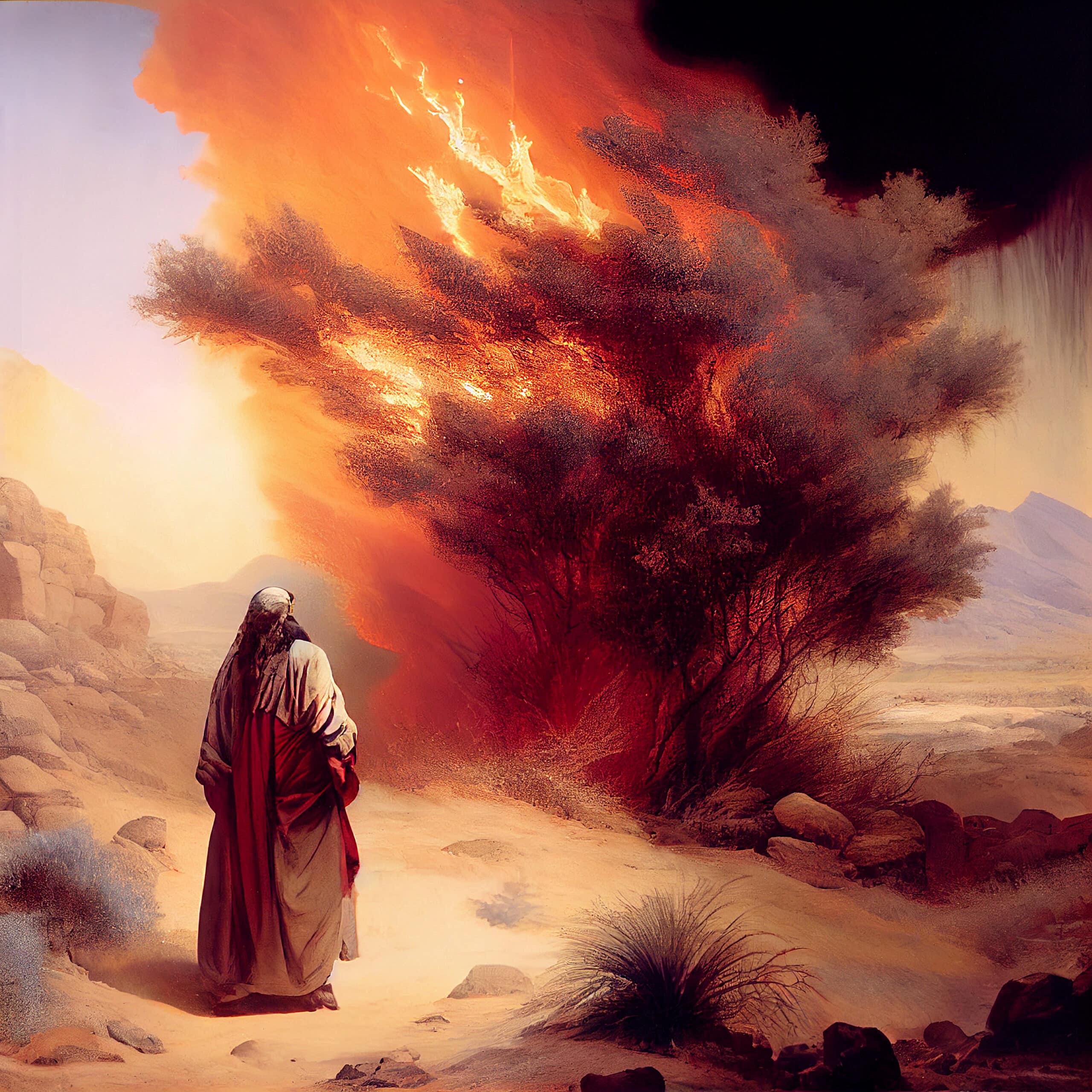
Image credit: One for Israel Ministry
Why a Thorny Bush?
This is one of the more unusual connections made in the original teaching.
The article points to the biblical theme of thorns as part of the curse described in Genesis. From there, it draws a line from the thorny bush to Christ bearing the consequences of sin, including the famous crown of thorns placed on Jesus during his crucifixion.
That is not a straightforward statement that Exodus 3 explicitly says, “This bush represents Jesus’ future crown of thorns.” Instead, it is a theological pattern the author sees across Scripture.
And that distinction matters.
Bible study becomes much healthier when we can say, “This passage clearly says this,” and, separately, “This is a Christ-centered connection I see across the biblical story.”
The companion article God Provides Himself the Lamb uses a similar Christ-centered approach when reading Genesis 22 and the ram caught in the thicket.
What Does “I AM” Mean in Exodus 3?
Moses eventually asks the question many readers have wondered about for centuries:
What is your name?
The answer is “I AM WHO I AM.”
The name is then connected with the divine identity Israel is to remember through generations.
The phrase has enormous significance in Christian theology because the Gospel of John repeatedly uses “I am” language in presenting Jesus’ identity.
Jesus says things such as “I am the bread of life,” “I am the light of the world,” and, most strikingly, “before Abraham was, I am.”
The original teaching therefore sees Exodus 3 and the Gospel of John as deeply connected.
The article Jesus: The True Bread from Heaven explores another of John’s major “I am” themes and connects Jesus with the Old Testament story of manna.
Did Jesus Appear Before Bethlehem?
This is one of the biggest questions raised by the burning bush story.
Traditional Christian theology has a category for appearances of the Son before his incarnation: a pre-incarnate appearance of Christ, sometimes called a Christophany.
Not every Christian interpreter identifies every appearance of “the angel of the Lord” as Jesus. Some understand the figure differently. So this should be presented as a theological interpretation, not as a universally agreed fact.
But the idea is fascinating because it changes the way you read the Old Testament.
Jesus would not simply arrive halfway through the Bible and suddenly become the center of God’s story. Instead, Christians can read the earlier Scriptures as a story moving toward the revelation of Christ.
The post Experiencing Jesus Opens the Bible: Seeing Jesus explores precisely this kind of Christ-centered reading of Scripture.

Image credit: Is That in the Bible?
What Does the Burning Bush Have to Do With Jesus’ Death?
The original teaching makes a dramatic connection here.
Jesus goes to the cross.
He is surrounded by suffering, rejection, violence, and death.
Yet death does not get the final word.
That is why the unconsumed bush becomes such a powerful picture in this interpretation. The fire does not get the final word. The destruction does not get the final word.
Life does.
The Living Room Theology article connects this idea with Paul’s statement in 2 Corinthians 5 and Peter’s description of Christ bearing sins in his body. The conclusion is that Jesus entered fully into the consequences of human sin while remaining victorious over death.
The related article Why Did God Send Jesus? develops another side of this theme, describing Jesus’ mission in terms of life, light, and salvation.
Why Is Forgiveness at the Center?
This is where the burning bush story becomes intensely personal.
The original article does not stop at symbolism. It asks what the burning bush reveals about how Christians should live.
The answer is forgiveness.
Jesus’ death is interpreted not simply as an event that happened to him, but as an expression of self-giving love and forgiveness. On the cross, Jesus prays for those responsible for his death.
Then the resurrection becomes the ultimate picture of life defeating death.
That naturally leads to a difficult question:
What does it look like to live as someone who has received forgiveness?
The answer cannot simply be, “I was forgiven, so that’s nice.” It has to reshape our relationships.
The article Why Did Jesus Breathe the Spirit on the Disciples? continues this theme by connecting Jesus’ post-resurrection appearance, the Holy Spirit, peace, and the call to forgive.
Forgiveness Does Not Mean Pretending Nothing Happened
This deserves some care.
Forgiveness does not mean saying that harmful behavior was acceptable. It does not mean ignoring injustice, abandoning healthy boundaries, or refusing to seek help when someone is dangerous.
Christian forgiveness is better understood as refusing to make hatred the final ruler of your heart.
That is much harder than it sounds.
Anyone can talk about forgiveness while the coffee is still warm and nobody has offended them before breakfast.
The real challenge comes when forgiveness costs something.
That is why the original article connects the burning bush with the practical command of Jesus to forgive others.
For another related discussion, see What Is Required for Love?.
The “Burning but Not Consumed” Picture of Christian Hope
There is something deeply encouraging about this image.
A bush can be surrounded by fire without disappearing.
For Christians, that can become a picture of hope in seasons when life feels like it is on fire—grief, disappointment, fear, uncertainty, or spiritual exhaustion.
It does not mean suffering is imaginary.
It means suffering does not necessarily get the final sentence.
The original teaching sees Jesus as the ultimate fulfillment of this pattern: he suffered, died, and rose again.
The Gospel of John repeatedly presents Jesus in terms of life and light, and the article Anointed Three Times – David and Jesus explores another Old Testament-to-Christ connection found by the site’s author.
What Can Moses’ Encounter Teach Us Today?
Moses’ story begins with him simply paying attention.
He notices the strange thing.
He turns aside.
He listens.
Then everything changes.
That can make a surprisingly practical lesson for modern Bible readers. We often rush through Scripture looking for information. But what happens when we slow down enough to notice the details?
Who is speaking?
Why does the text use this particular description?
What does the passage say about God’s character?
How does the New Testament interpret these Old Testament themes?
The Bereans and their daily examination of Scripture article encourages readers to approach biblical interpretation thoughtfully rather than simply accepting every conclusion handed to them.
Read Exodus 3 With Fresh Eyes
The next time you read Exodus 3, don’t rush past the famous scene just because you’ve heard it a hundred times.
Notice the setting.
Notice the fire.
Notice that the bush is not consumed.
Notice the holiness of the ground.
Notice Moses asking for God’s name.
Notice the words “I AM.”
Then read John alongside Exodus and ask how the Gospel presents Jesus’ identity.
You can also explore How Do You Hear the Word of God?, which encourages a slower, more reflective way of engaging biblical passages.
And remember one important Bible-study habit: don’t confuse an interesting interpretation with the only possible interpretation. Let the text speak, compare passages, examine the context, and allow room for thoughtful Christian disagreement.
Why the Burning Bush Still Matters
The burning bush is much more than a spectacular Bible story.
At its heart, Exodus 3 is about divine presence. It is about holiness. It is about God’s name. It is about calling Moses into a mission. And, in the Christ-centered reading presented by Living Room Theology, it becomes a powerful window into Jesus as the eternal “I AM.”
The image is unforgettable: fire without destruction, suffering without the final victory of death, and divine presence in the middle of an ordinary wilderness.
That is why this story keeps drawing readers back.
The wilderness looks ordinary until Moses stops to look.
The bush looks fragile until the fire fails to consume it.
And the mysterious voice sounds strange until the name is spoken: I AM.
For Christians who read Exodus through the lens of Jesus, the burning bush can therefore become a reminder that the story of Christ does not begin merely at Bethlehem. It invites readers to look backward through Scripture, see the patterns, and ask one of the Bible’s biggest questions:
Who is the One who is present in the fire, speaks with divine authority, and remains the living One after death?
That question is still worth turning aside to explore.
Isaiah 61:1 The Spirit of the Lord GOD is upon me; because the LORD hath anointed me to preach good tidings unto the meek; he hath sent me to bind up the brokenhearted, to proclaim liberty to the captives, and the opening of the prison to them that are bound; 61:10 I will greatly rejoice in the LORD, my soul shall be joyful in my God; for he hath clothed me with the garments of salvation, he hath covered me with the robe of righteousness, as a bridegroom decketh himself with ornaments, and as a bride adorneth herself with her jewels.
Thanks goes to God Almighty for inspired you through this medium for a person like me to understand Jesus as the burning that was burnt but not consume ,burnt but not destroyed .
Hallelujah to God