
Video credit: Messages of Christ / Scripture Central
How long did it take to build the Tabernacle of Moses?
At first, that sounds like the sort of question that belongs in a Bible trivia contest. But once you start following the dates in Exodus, it becomes surprisingly interesting.
The Bible spends a huge amount of space describing the Tabernacle: its curtains, frames, coverings, furniture, priestly garments, materials, measurements, and craftsmen. Exodus 25–31 gives the blueprint, while Exodus 35–40 describes the actual construction and setup. Modern Bible-study resources also recognize this as one of the major sections of the book of Exodus. See the Exodus overview from BibleProject.
But there is a deeper question hiding underneath the timeline:
Was the Tabernacle simply a portable place of worship, or does its timing point toward something much bigger?
The original Living Room Theology article connects the Tabernacle with Jesus and focuses especially on the remarkable timing between the giving of its instructions and its erection. That connection is fascinating, but there is an important detail modern readers should know: the Bible does not explicitly say, “The Tabernacle took exactly nine months to build.” The nine-month idea comes from connecting the arrival at Sinai and the eventual setup in the first month of the second year. The exact amount of time spent on construction itself is more difficult to establish.
That little distinction actually makes the story more interesting, not less.

Image credit: Bible Hub
Why Did God Tell Israel to Build the Tabernacle?
Before we talk about months and dates, we need to understand what the Tabernacle was actually for.
God told Moses to have the Israelites bring offerings and build a sanctuary so that he could dwell among them. This was not simply a giant desert tent for religious meetings.
It represented the presence of God among his people.
The Tabernacle was portable because Israel was traveling through the wilderness. It could be dismantled, carried, and set up again as the nation moved. In that sense, it was almost like a traveling palace—but instead of a king moving from city to city, the presence of God traveled with his people.
The detailed instructions are laid out in Exodus 25–31, and the construction is then described in Exodus 35–40. Read Exodus 25–40 in context.
This attention to detail is one reason the original article asks readers to slow down and notice the seemingly small things. The author sees the Tabernacle as a picture that ultimately points toward Jesus.
The Exodus Timeline Begins With Passover
The timeline becomes much easier to follow once we begin at the start of Israel’s departure from Egypt.
Exodus 12 establishes the first month for Israel and gives the instructions for Passover. The Israelites then begin their journey out of Egypt.
One month later, Exodus 16 places Israel in the wilderness of Sin, where God provides manna. Then Exodus 19 says that Israel arrives at Mount Sinai in the third month after leaving Egypt.
That third-month arrival is the major time marker in the Tabernacle story.
According to Exodus 19, Israel arrives at Sinai, and Moses goes up the mountain. The chapters that follow describe the covenant, the commandments, and then the detailed instructions for the sanctuary.
You can explore the site’s Bible Study: Why? How? What? for a broader look at the author’s approach to reading the Bible and looking for connections across Scripture.
When Were the Tabernacle Instructions Given?
Exodus 25 begins with God instructing Moses to receive offerings from the people and construct a sanctuary.
The list is impressive.
Gold. Silver. Bronze. Blue, purple, and scarlet yarn. Fine linen. Animal skins. Acacia wood. Oil. Spices. Precious stones.
And then comes the purpose:
“Let them make me a sanctuary, that I may dwell in their midst.”
That’s the heart of the whole project.
God was not asking Israel to build an impressive structure simply because impressive structures are fun. The goal was God’s presence among his people.
The Tabernacle therefore becomes a physical picture of something much bigger: God dwelling with humanity.
That theme becomes especially important when Christians read John 1:14, where John says that the Word became flesh and “dwelt” among us. The Greek verb has the sense of tabernacling or dwelling in a tent.
That connection is central to the original article’s interpretation and is also why the site’s Jesus: I Am the Burning Bush article emphasizes the idea of Jesus as God’s presence appearing among humanity.
So, Did the Tabernacle Really Take Nine Months?
Here’s where we should slow down.
The original article proposes a striking nine-month pattern. Israel arrives at Sinai in the third month of the first year. Then, in Exodus 40:1, God tells Moses to erect the Tabernacle on the first day of the first month of the second year.
At a glance, that gives an interval of roughly nine months.
And that’s the source of the famous comparison to pregnancy: the Tabernacle is described as being “conceived” with God’s instructions and later “born” when it is erected.
It is a memorable analogy.
But we should be precise with our wording. The text gives the dates for major events, not a stopwatch showing the exact number of construction days.
There are also substantial periods of time involving Moses on Mount Sinai, including multiple forty-day periods. The original article’s comments even include readers questioning whether the nine-month construction interpretation works as neatly as it first appears.
So a careful Bible study would say this: the Tabernacle was erected on the first day of the first month of the second year, and the broader interval from Sinai to that event is roughly nine months. Whether that should be called a literal nine-month construction period is an interpretation, not an explicit statement from Exodus.

Image credit: Jovens Adventistas do Sétimo Dia
Why Is the First Day of the New Year So Important?
Exodus 40 does something very deliberate with the date.
The Tabernacle is set up on the first day of the first month of the second year.
That is not just another random date in the wilderness journal.
A year has passed since Israel began its journey from Egypt. The people now have a sanctuary. They have a priesthood. They have a place where God’s presence is manifested among them.
Then something spectacular happens.
The cloud covers the Tent of Meeting.
The glory of the Lord fills the Tabernacle.
And Moses cannot enter because the glory is so overwhelming.
That moment is the dramatic climax of the construction story.
It’s as though the building project is finally finished and heaven itself says, “Now we’re open.”
The Glory Fills the Tabernacle
Exodus 40:34–35 describes the cloud covering the Tent of Meeting and God’s glory filling the Tabernacle. Moses is unable to enter while the glory remains there.
This matters enormously when we move to the Gospel of John.
John 1:14 says that the Word became flesh and dwelt among us, and that people saw his glory.
The language creates a powerful connection for Christian readers. The Tabernacle was a place where God’s glory dwelled among Israel. John presents Jesus as the Word who comes to dwell among humanity.
The original Living Room Theology article sees this as more than a loose similarity. It views the Tabernacle as a picture pointing toward Christ.
The site’s Jesus: The True Bread from Heaven develops another example of this approach, connecting Old Testament wilderness imagery with Jesus’ teaching in John.
Why Does John Compare Jesus With the Tabernacle?
John’s Gospel begins with an enormous claim: the Word was with God, the Word was God, and the Word became flesh.
Then comes the statement that the Word “dwelt” among us.
That wording is important because the Tabernacle was, quite literally, a dwelling place in the wilderness.
The comparison becomes even richer when John says believers saw Jesus’ glory and describes him as being full of grace and truth.
The original article contrasts that with Moses and the giving of the law. The point is not that Moses was unimportant. Far from it. Moses is central to the Exodus story. Rather, the Christian argument is that the Tabernacle’s role as a dwelling place of divine presence ultimately finds a greater expression in Christ.
This is one reason the site’s Three 40s: Comparing Moses and Jesus article compares Moses and Jesus as figures representing different moments in the biblical story.
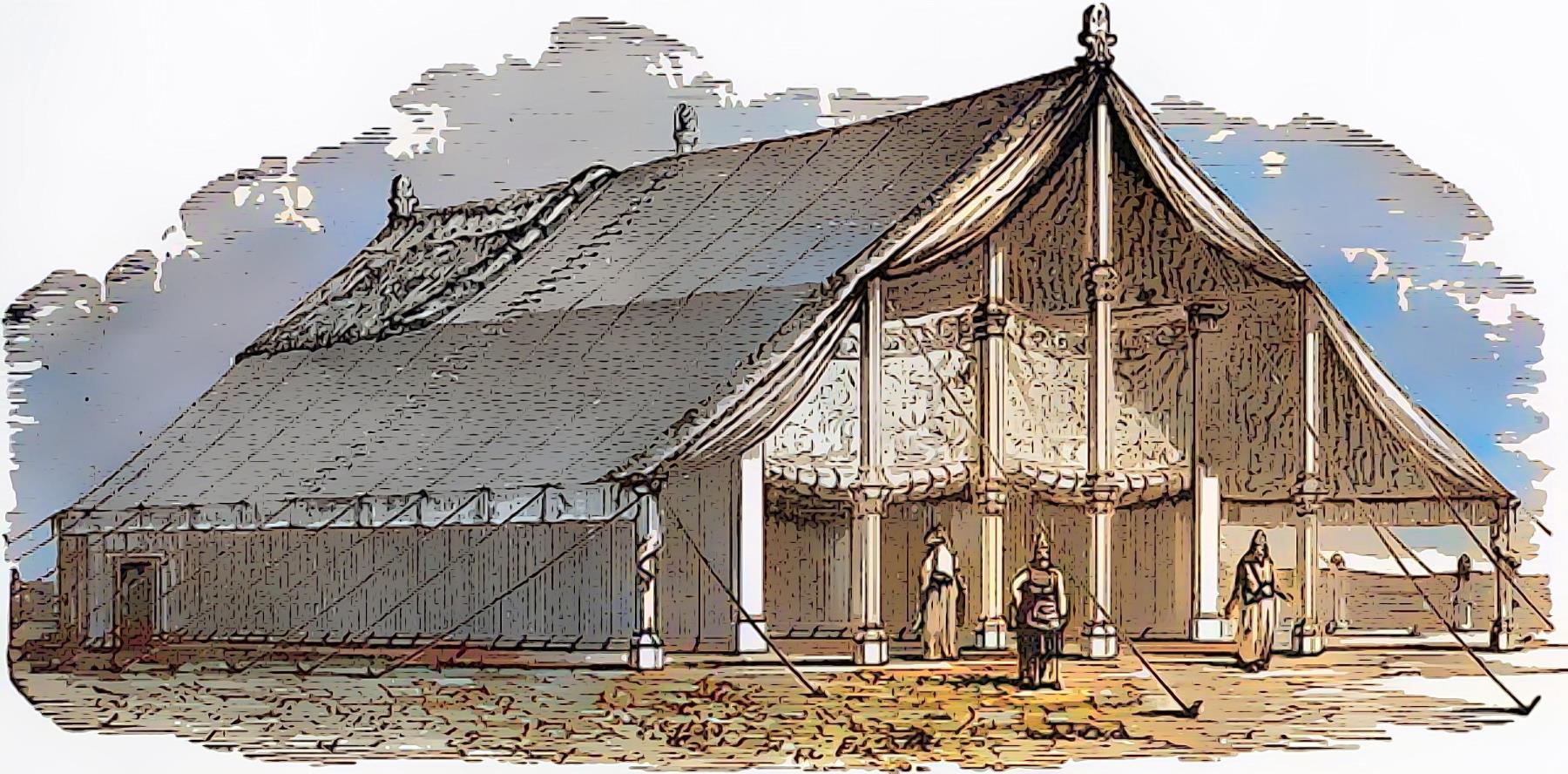
Image credit: Bible Hub
Is the Tabernacle a Picture of Jesus?
This is where interpretation enters the conversation.
Christian readers have long seen connections between the Tabernacle and later New Testament ideas about God’s presence, sacrifice, priesthood, holiness, and access to God.
The New Testament itself repeatedly uses Tabernacle and Temple imagery when explaining Jesus’ work.
At the same time, not every Christian tradition will agree with every symbolic connection proposed by an individual Bible teacher. That’s why it helps to distinguish between what Exodus directly states and what a Christian interpreter sees as typology or theological symbolism.
The original Living Room Theology approach is strongly Christ-centered. The site’s Experiencing Jesus Opens the Bible: Part 4 – Seeing Jesus explains why the author believes Jesus changes the way Scripture is read.
That is a useful distinction: the Bible tells us what happened, while theological reflection asks what those events reveal within the larger biblical story.
The Tabernacle and Jesus as the True Dwelling Place
The word “tabernacle” can sound remote and ancient. But its central idea is wonderfully simple:
God dwelling with people.
That’s the thread worth following.
God dwells among Israel in the wilderness.
Later, the Temple becomes the central sanctuary in Jerusalem.
Then John presents Jesus as the Word who dwells among humanity.
Finally, the New Testament looks toward the ultimate fulfillment of God’s dwelling with people.
The original article’s I Will Build You a House also explores the biblical theme of God building or dwelling in a house, adding another layer to the larger biblical pattern.
What About the Ark, the Curtains, and All Those Details?
Here’s the funny thing about Exodus: God apparently did not believe in leaving the Tabernacle instructions to “just use your best judgment.”
The details are extraordinarily specific.
There are instructions for curtains, frames, sockets, poles, coverings, lampstands, tables, altars, priestly garments, incense, and the Ark of the Covenant.
At first glance, this can feel like reading the ancient equivalent of a very long assembly manual.
But the repetition has a purpose.
The Bible slows down.
It makes you notice.
Modern BibleProject study material points out that the Tabernacle instructions echo themes from Genesis and that the narrative gives substantial attention to the sanctuary and its furnishings. Explore the Exodus Tabernacle overview.
For the original author, all those details matter because they form a pattern that ultimately points toward Jesus.
The site’s God Provides Himself the Lamb article uses the same kind of Christ-centered reading with the story of Abraham, Isaac, and the ram.
Why the Timing Matters to Christian Bible Study
Even if you don’t accept every part of the nine-month analogy, the timeline still teaches something valuable.
God’s work is unfolding within time.
The Exodus story records dates.
The wilderness journey has stages.
The Tabernacle is planned before it is built.
Then it is completed, erected, and filled with glory.
That sequence naturally creates a larger biblical rhythm:
- Promise — God gives the pattern.
- Preparation — the people gather materials and build.
- Dwelling — the Tabernacle is erected.
- Glory — God’s presence fills it.
For Christians, it is tempting to see that rhythm echoed in the story of Jesus: promise, preparation, incarnation, and the revelation of divine glory.
Whether you see every connection as intentional prophecy or as theological pattern, it is certainly worth studying.
The Tabernacle Was Built in the Wilderness
There is another detail that can easily get overlooked.
The Tabernacle wasn’t built after Israel had settled comfortably in a beautiful city.
It was built while they were still traveling.
They were pilgrims.
They were not yet home.
That makes the image of a portable sanctuary especially powerful. God’s presence was not waiting for Israel at the end of the journey. The presence of God traveled with them.
The site’s Bible study guide emphasizes reading Scripture as a connected story rather than as isolated passages. That’s especially useful with Exodus because the wilderness, manna, Tabernacle, covenant, priesthood, and later New Testament themes continually overlap.
What Can the Tabernacle Teach Us Today?
For modern readers, the Tabernacle can feel like a distant archaeological curiosity.
But its central question remains surprisingly current:
Where do we believe God is present?
The original Christian interpretation points readers toward Jesus as the greater dwelling place of God.
That shifts the focus from architecture to relationship.
You don’t have to understand every measurement before you can appreciate the central idea. The point is that God desired to dwell among his people.
The site’s Why Did God Send Jesus? develops this larger theme by focusing on Jesus, divine life, and God’s purpose in sending his Son.
And for readers who want to study the Scriptures carefully rather than simply accept a clever theory, the Bereans examining the Scriptures daily article is a useful reminder to test what we hear.
What Is the Most Important Part of the Story?
It may not actually be the nine months.
It may not even be the exact construction timeline.
The most important detail is what happens when the Tabernacle is finally erected.
God’s glory fills it.
That is the moment toward which the entire project has been moving.
And that is why John 1 becomes so important for Christian readers. John says the Word became flesh and dwelt among us, and that his glory was seen.
The original Living Room Theology article sees the Tabernacle and Jesus as part of one continuous story: God’s presence moving from a wilderness sanctuary toward the person of Christ.
The related article Jesus: I Am the Burning Bush follows another Exodus image into the New Testament and asks readers to see Jesus at the center of the biblical story.
So How Long Did It Take to Build the Tabernacle?
Here’s the careful answer.
The Bible does not give a simple statement saying, “The Tabernacle took nine months to construct.”
What Exodus does tell us is that Israel arrived at Mount Sinai in the third month after leaving Egypt, and the Tabernacle was erected on the first day of the first month of the second year.
That creates an interval of roughly nine months between those major markers.
The original Living Room Theology article interprets that interval as a nine-month “conception to birth” pattern and connects it with the birth of Jesus. It then points to John 1:14 and the idea of the Word dwelling, or tabernacling, among humanity.
That is a memorable theological insight—but it should be presented as an interpretation rather than as a directly stated construction time.
And perhaps that is the best reason to study the timeline in the first place.
Not merely to win Bible trivia.
Not merely to say, “Look! Nine months!”
But to slow down long enough to notice how the biblical story connects presence, dwelling, glory, Jesus, and the human longing to be near God.
The Bigger Picture: From Tabernacle to Jesus
The Tabernacle began as a portable sanctuary in the wilderness.
It was carefully designed.
It was assembled according to a pattern.
It became the center of Israel’s worship.
And when it was finally erected, the glory of the Lord filled it.
For Christians, the New Testament then gives us the astonishing statement that the Word became flesh and dwelt among us.
That’s the connection worth remembering.
The Tabernacle points beyond itself to the idea of God dwelling with humanity.
And the Christian proclamation is that this reaches its fullest expression not in a tent, but in Jesus Christ.
The site’s Seeing Jesus article puts that Christ-centered reading at the heart of its approach to Scripture.
Final Thoughts on the Tabernacle Timeline
The next time you reach the long sections of Exodus describing curtains, poles, gold, wood, measurements, garments, and furniture, resist the urge to think, “Here comes the boring part.”
Look again.
Notice the dates.
Notice the sequence.
Notice the purpose.
Notice what happens when the Tabernacle is complete.
And then turn to John 1.
Suddenly, the ancient wilderness tent does not seem quite so distant.
The real question was never only, “How long did it take to build the Tabernacle?”
The bigger question is:
“Why did God want to dwell among his people—and how does that story lead us to Jesus?”
That is where this ancient construction project becomes much more than an old tent in the desert.
It becomes part of a story about God’s presence, glory, and the astonishing Christian claim that the Word became flesh and dwelt among us.
What it seems like you missed here is that 1 nissan would be the birth of messiah.
I have been reading my Chronological Bible with anticipation of completion in a year or less. The instructions were SO DETAILED! HOLY ‼️ I HAD TO STOP & GOOGLE TO SEE HOW LONG IT TOOK!!!!! I’M IN AWE ! Thank you for your answers to our questions!
God Richly Bless You!
My understanding is that it took 3 mo. To get to Sinai. Then Moses was in Mt. 40 days the first time – so over a mo. Then again in the mt. another 40 days when the Tabernacle plans were given. Wouldn’t that mean it would have been conceived in that second 40 days – which would make the building of the Tabernacle take closer to 6 months?
Thank you for your explanation it was/Is exactly what I was looking for.
Be safe and God Bless
Excellent explanation of the tabernacle construction and time frame. I was impressed. Thank you. Made me feel like preaching. Again thank you .
I am surprised that this incorrect teaching is still up after ‘GM’ correctly rebuked the erroneous schedule.
Let’s put it in modern months:
March 1 (Sivan) Arrival at Mt. Sinai
Unknown time before Moses goes up
1st fast of Moses; 40 days; see Deu 9:9 ‘… remained on the mountain forty days and forty nights, I did not eat food and I did not drink water …’
2nd fast of Moses; 40 days; see Deu 9:18-25 ‘I lay prostate before Yahweh, AS EARLIER, forty days and forty nights’
3rd fast of Moses; see Deu 10:1-5 and Exo 34:1-29 ‘…Cut for yourself tablets like the first ones […] … he was there with Yahweh forty days and forty nights. He ate no food and drank no water.
= Total fast of 120 days (4 months) plus the unknown times before and in between the fasts
March 1st plus 120 days means already July 1st (Ethanim), resulting in a difference of 6 months to the new year.
The 9 months could still be true if we acknowledge that the Tabernacle was surely not set up entirely on the first day of the year (if you want to compare it to a pregnancy it has to fully function = being born and being alive). Thousands of people were involved in the construction and it is obvious that such a complex structure must have required a couple of days to be set up, at least for the first time even though inspired by the Spirit.
But on the other hand they surely did not require 3 months to fully set it up and dedicate it to the Lord.
Therefore I do not see any possibility to successfully construct a 9-month-Tabernacle-theory, as beautiful this analogy would be. Let us stick to the Word and do not twist it for our wishful thinking in order to find a spectacular story. Remember that those who are teaching will be judged much more strictly. Repent and He will forgive you.